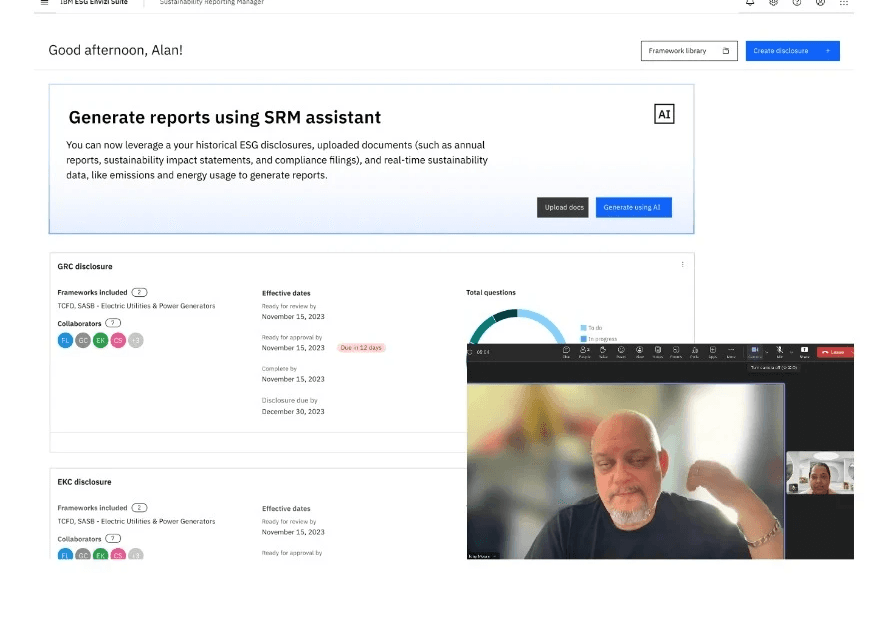
Designing Responsible AI for Enterprise Sustainability Reporting
Sustainability managers across industries were struggling with fragmented and complex disclosure processes in IBM’s Sustainability Reporting Manager (SRM). To comply with ESG frameworks like ESRS, SEC, and GRI, they needed to gather data across multiple modules (SRM, Financed Emissions, Supply Chain). The issues were clear: • Time drain: Managers lost 30–40% of reporting time cross-checking scattered data. • High rework: Submissions were rejected or flagged due to incomplete or inconsistent information. • Low trust in automation: Early AI suggestions were seen as “black boxes” without traceable reasoning.
Why did it matter to us?
For IBM, Envizi had to compete with rising players like Workiva that were already offering AI-augmented reporting tools. If IBM couldn’t prove that its AI could reduce disclosure risk while improving efficiency, large enterprise clients would move elsewhere.
For users, the stakes were personal: a missed or flawed disclosure could cost their company millions—and their own reputation. They needed a tool that was not only fast but also auditable and trustworthy.
How my model addressed it
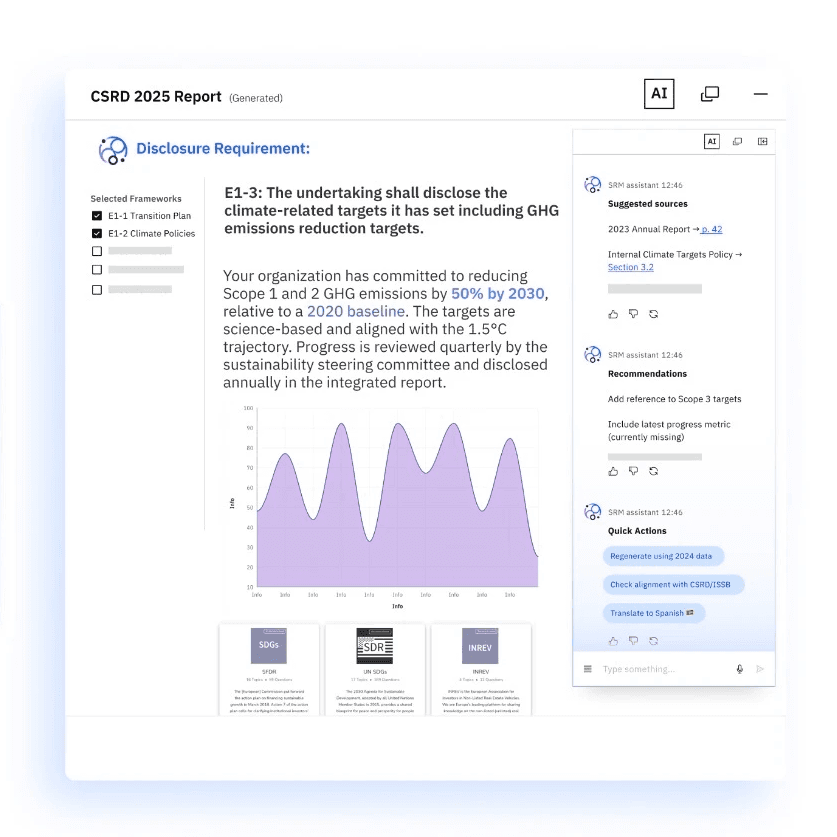
I designed the SRM AI Assistant with a Human–AI Interaction (HAI) framework focused on explainability, guidance, and cross-suite integration.
AI-Guided Workflows
Adaptive sequencing of disclosure steps.
“What’s next?” nudges to reduce dead-ends and wasted effort.
Explainability Layer
Every AI recommendation included a “Why am I seeing this?” panel.
Traceable links back to specific datasets and framework clauses.
Personalization & Learning
Assistant learned from past disclosures to suggest recurring data inputs.
Context-aware fetching from Financed Emissions or Supply Chain modules.
How it impacted business
For enterprises:
25–30% reduction in disclosure preparation time.
20% fewer rework cycles, lowering compliance overhead.
Improved confidence in regulatory alignment, reducing audit risks.
For IBM:
Positioned Envizi as a trusted, explainable AI product.
Differentiated against competitors by balancing speed + auditability.
Opened cross-selling opportunities across the Envizi suite.
What were the consequences of taking actions through this model?
Positive Consequences
Faster reporting cycles free up sustainability teams for strategy, not firefighting.
Transparent AI builds user trust and long-term adoption.
Compliance-ready workflows strengthen IBM’s credibility with enterprise clients and regulators.
Strategic Consequences:
By leading with responsible AI design, IBM could shape regulatory conversations around explainability in ESG tools.
Early adoption of this model would make IBM less vulnerable to reputational risk if AI errors occur, since reasoning is always visible.
Missed Consequence if ignored:
If IBM had not acted, Envizi risked losing enterprise clients to competitors, and users would continue wasting resources on manual rework—weakening IBM’s market positioning.